
ACL Rehabilitation Northern Ireland: Return-to-Sport Guide
Knee Ligament and ACL Rehabilitation demands strength and function before surgery, not just after, prehabilitation builds the foundation for recovery. At Active Therapy Clinic, Chartered and HCPC-registered physiotherapists serving patients throughout Northern Ireland from our Lurgan and Lisburn sites guide clients through structured pre-op, post-op, and return-to-sport protocols, open Saturdays 9:00am–3:00pm for continued care.
Effective ACL rehabilitation in Northern Ireland combines pre-operative prehabilitation with structured post-surgical protocols to restore strength, motion, and confidence. Active Therapy Clinic’s HCPC and CSP Chartered physiotherapists, serving Lurgan. Lisburn, design individualized programs progressing patients through strength, balance, and sport-specific training, guiding safe return-to-sport decisions rather than fixed timelines alone, backed by 450+ five-star reviews.
What Happens After a Knee Ligament Injury?
A torn ACL sets off a chain reaction: swelling, instability, and muscle weakness that begins within hours of the injury. Northern Ireland patients who delay treatment risk losing strength and range of motion before surgery ever takes place. Recovery outcomes actually depend on what happens in the weeks before reconstruction, not just after it. Long-term ACL research confirms that a stronger, more functional knee going into surgery translates directly into a stronger, more functional knee coming out.
This pre-surgical window matters as much as the operation itself. Skipping it means starting rehabilitation from a deficit, one that costs patients precious weeks of recovery time later.
Does Rehab Matter Before or After ACL Surgery?
Both phases carry weight, but they serve different purposes. Prehabilitation builds strength and blood flow ahead of the operation, giving the joint a head start on healing. Rehabilitation following reconstruction is described as an essential part of achieving a full recovery, addressing the muscle atrophy, joint stiffness, and stability loss that follow surgery.
What Does Post-Injury Care Typically Involve?
Care progresses through distinct stages rather than a single fixed program:
- Reducing swelling and protecting the joint immediately after injury
- Restoring range of motion and muscle activation before surgery
- Rebuilding strength, balance, and control after reconstruction
- Progressing toward sport-specific movement patterns as healing allows
Knee ligament physiotherapy across Northern Ireland, available at our Lurgan and Lisburn sites, addresses each stage individually, since sports injuries and post-operative joint rehabilitation demand different clinical approaches at different points in recovery. Active Therapy Clinic is Northern Ireland’s leading award-winning private clinic, with two premier sites staffed by Chartered physiotherapists guiding patients through prehabilitation and post-surgical phases. Structured, professionally guided care at every stage protects long-term joint health far more reliably than an unsupervised approach.
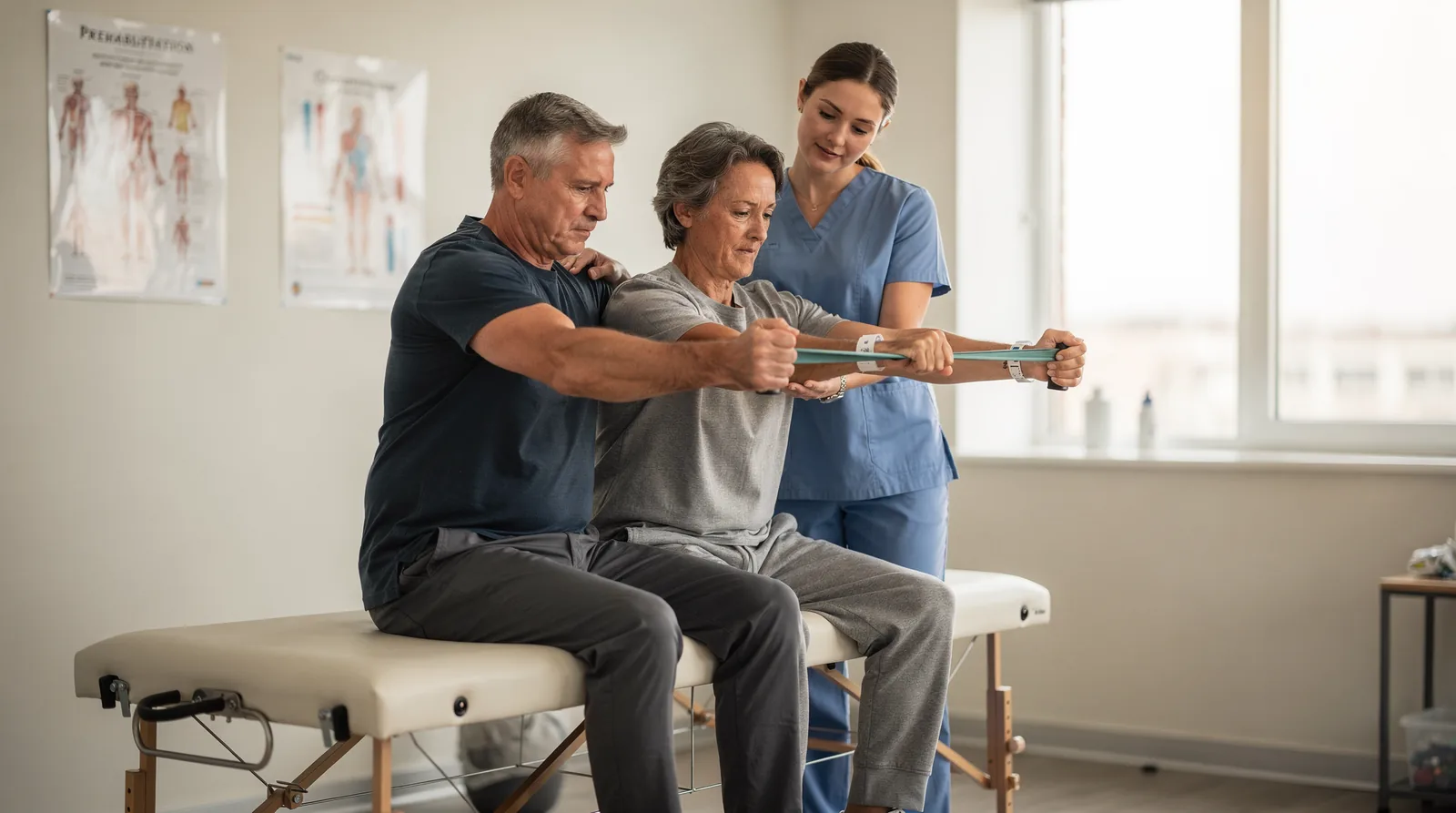
Why Does Pre-Surgery Prehabilitation Matter?
Knee strength and function before surgery determine how far ahead a patient starts the road to recovery. Long-term ACL research confirms this: the stronger and more mobile the injured knee going into the operating theater, the further along rehabilitation progresses afterward. For patients across Northern Ireland weighing up ligament reconstruction, this pre-surgery window carries real weight.
This preparation phase has a formal name: prehabilitation, or prehab for short. Prehab is not optional busywork before surgery. It targets specific physical deficits that, left unaddressed, slow every stage of post-operative recovery.
Prehab exercise programs work toward two goals in particular:
- Building muscle strength and control around the injured joint
- Increasing blood flow to the knee, which supports tissue healing and reduces post-surgical stiffness
Clinicians delivering knee ligament physiotherapy across Northern Ireland, from our Lurgan and Lisburn sites, structure prehab sessions around these same principles, adapting them to each patient’s sport, occupation, and baseline fitness.
What is the most important prehab goal before ACL surgery?
Full extension of the injured leg ranks among the two most critical goals, both before and after surgery. A knee that cannot fully straighten going into the operating theater tends to struggle with the same limitation afterward, delaying gait recovery and strength work. Physiotherapists prioritize restoring this range of motion early, often before tackling strength gains.
Does prehab replace physiotherapy after surgery?
No. Prehab sets the foundation; post-operative rehabilitation builds on it. Patients who arrive at surgery with better strength, motion, and blood flow typically progress faster through the structured phases that follow, including the eventual return to sport testing for ACL patients. Skipping prehab does not prevent surgery from succeeding, but it does remove an advantage that is difficult to recover later. ACL rehabilitation in Northern Ireland increasingly starts before the surgical date, not after it, reflecting this evidence.
What Does Post-Operative ACL Rehab Involve?
Post-operative ACL rehabilitation Northern Ireland patients receive follows a structured protocol built around clear instruction, direction, and functional goals. This framework guides recovery from the earliest days after reconstruction through to full activity. Rather than a rigid checklist, the protocol acts as a roadmap that clinicians adapt to each patient’s presentation.
A chartered physiotherapist applies professional judgment throughout this process. No two knees respond identically to surgery. The clinician interprets the general protocol and shapes it into a treatment plan suited to the individual in front of them. This clinical reasoning determines exercise selection, loading progression, and the pace at which milestones get introduced. Knee ligament physiotherapy across Northern Ireland follows this same principle: structured guidance, individually applied.
Progress after ACL surgery rarely follows a straight line. Two patients operated on the same week can present very differently six weeks later, depending on pre-operative strength, swelling response, and general conditioning. Because of this variability. Because each patient carries different pre-operative deficiencies, the rehab plan must be individualized rather than applied uniformly.
Why does ACL rehab look different from one clinic to another?
Exercise selection often depends on the equipment available at a given facility. A clinic with access to specific strength or balance equipment may sequence exercises differently than one without it, even while following the same underlying protocol. This is one reason working with a properly equipped, chartered clinic matters for outcomes.
Typical elements woven into an individualized plan include:
- Range-of-motion work introduced progressively after surgery
- Graduated strengthening targeting the quadriceps, hamstrings, and hip muscles
- Balance and proprioception drills to restore joint control
- Sport-specific and functional loading exercises as milestones are met
Each stage builds toward one outcome: a knee capable of returning safely to sport or daily demands.

What Should You Expect Week by Week?
Recovery timelines answer different questions at different stages. Most patients rehabilitating a torn ACL want more than a general phase chart. They want to know what this specific week should look like. Practical concerns dominate: whether swelling counts as normal, when the brace comes off, and whether progress sits on track.
A broad clinical framework groups ACL rehabilitation in Northern Ireland into six distinct phases, according to ACL Surgery Recovery Week by Week from Jeremy Burnham, MD. Each phase spans roughly 6 to 12 weeks and covers a stage of tissue healing, strength rebuilding, and neuromuscular control. That structure gives useful milestones, but it moves slowly compared to how recovery actually feels day to day.
A week-by-week view fills that gap. Patients in Lurgan, Lisburn, and across Northern Ireland benefit from knee ligament physiotherapy in Lurgan and Lisburn that translates the six-phase framework into weekly targets: swelling checks, range-of-motion goals, brace weaning, and gradual loading. Instead of guessing whether a symptom is expected, patients get a checkpoint against which their specific week can be measured.
Is Some Swelling Normal Weeks After ACL Surgery?
Mild swelling commonly persists for several weeks following reconstruction and typically fluctuates with activity level. A clinician tracks swelling trends visit to visit rather than judging a single day in isolation. Sudden increases, warmth, or pain alongside swelling warrant clinical review.
When Does the Post-Op Brace Usually Come Off?
Brace removal depends on quadriceps control, swelling status, and surgeon protocol rather than a fixed calendar date. Clinicians assess strength and stability at each visit before advancing brace settings. Later phases incorporate return to sport testing for ACL patients, confirming readiness before unrestricted movement resumes. This staged approach keeps weekly progress measurable and reduces the risk of setbacks from advancing too quickly.
How Do You Choose the Right ACL Provider?
Credentials separate a capable ACL provider from a generic one. Patients recovering from ligament trauma need knee ligament physiotherapy in Lurgan and Lisburn delivered by Chartered. HCPC-registered clinicians, not a one-size-fits-all exercise sheet. Multidisciplinary teams matter here: physiotherapists, podiatrists, and sports massage therapists working together address the knee, the surrounding kinetic chain, and gait patterns that shift after surgery.
What Should Patients Look for in a Clinic’s Track Record?
Reputation offers a reliable signal of consistent care quality. An award-winning private clinic with a strong volume of five-star patient reviews. Recognition as a top-rated provider in Northern Ireland reflects outcomes that hold up across many cases, not just isolated successes. Checking review history and clinical accolades before committing to a program is a practical first step for anyone starting ACL rehabilitation in Northern Ireland.
Timing also shapes recovery outcomes. Long waiting lists delay the early strengthening window that research links to better postoperative results. Access to same-week appointments keeps rehab moving without costly gaps. A provider offering prompt booking, rather than a months-long queue, allows patients to begin structured loading and range-of-motion work while the window for progress is widest.
Program design deserves close scrutiny too. Post-surgical recovery plans should be customized to the individual, addressing joint stability, tendon health, and soft-tissue balance together rather than treating the knee in isolation.
Patients weighing local options should prioritize clinics that combine these four factors rather than choosing on convenience alone.
What Is Return-to-Sport Testing and Why It Matters?
Return to sport testing acl protocols measure whether an athlete’s reconstructed knee can withstand the demands of cutting, pivoting, and jumping before clearance to play resumes. Skipping this step carries real cost: athletes who return on confidence alone, rather than objective data, risk re-injury and a second lengthy layoff. For patients across Northern Ireland pursuing sport after ligament surgery, structured testing closes that gap between “feeling ready” and being ready.
Objective frameworks used in leading ACL recovery centers rely on the Limb Symmetry Index (LSI), which compares strength and function in the surgical leg against the healthy one. Recognized thresholds call for at least 70% symmetry at three months post-surgery, 85% by six months, and 95% by nine months. Cutting and pivoting sports, such as Gaelic football, rugby, and soccer, common across Northern Ireland’s active population, demand this full testing battery before an athlete steps back onto the pitch.
Does manual therapy help before return-to-sport testing?
Specialist manual therapy plays a supporting role in the weeks leading up to testing. Techniques that relieve muscle tension and release myofascial knots help restore normal movement patterns. Accelerate athletic recovery, giving muscles a better chance to perform at their true capacity during assessment.
What tools support late-stage conditioning?
Targeted compression recovery tools increase blood flow to specific areas of the leg during late-stage rehabilitation. That boosted circulation delivers oxygen. Nutrients that support tissue conditioning as athletes prepare for the demands of formal testing.
Clinics offering knee ligament physiotherapy Lurgan Lisburn patients trust typically combine strength testing, functional movement screening, and sport-specific drills. Anything less leaves return-to-play decisions based on guesswork rather than measured evidence.
What Setbacks Can Derail ACL Recovery?
Additional injuries alongside the torn ligament pose the biggest threat to a smooth ACL recovery. Meniscal tears or cartilage damage often accompany ligament trauma, and when these complications exist, standard rehabilitation timelines no longer apply. A knee that also needs cartilage protection heals on a different schedule than one dealing with the